


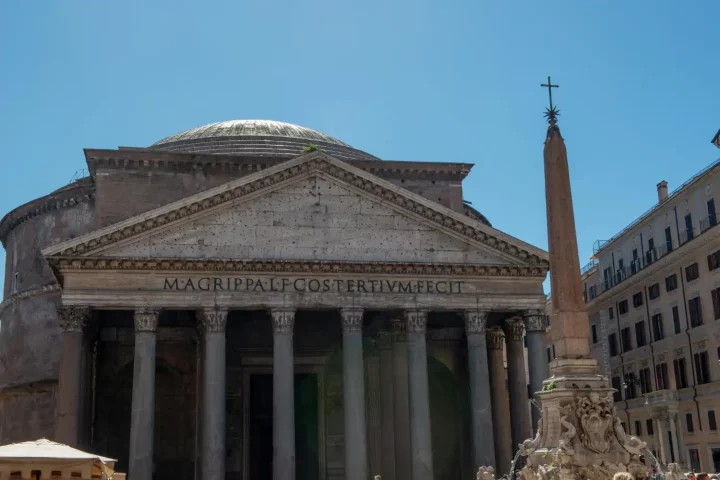
Standing at the heart of Rome, between Piazza Navona and Via del Corso, the Pantheon is one of the most extraordinary and best-preserved monuments of ancient Rome.
With its massive dome, elegant Corinthian columns, and mysterious oculus, the Pantheon has captivated architects, historians, and visitors for centuries.
Originally built as a temple to honor all gods, it has evolved into a Christian church and a mausoleum, all while maintaining its architectural integrity and cultural significance.
Historical context and architectural importance
The name “Pantheon” comes from the Greek words pan (all) and theos (gods), reflecting its original purpose as a temple dedicated to all of the gods. While the exact origins of the structure remain debated, Roman legend claims it was built in honor of Romulus, the mythological founder of Rome.
Historically, the first Pantheon was commissioned in 27 BC by Marcus Agrippa, a close ally of Emperor Augustus. This early version was likely a traditional rectangular temple with a gabled roof and surrounding colonnade.
However, the original structure was destroyed in the Great Fire of 80 AD and rebuilt by Emperor Domitian, only to be struck by lightning and burned again in 110 AD. The Pantheon as we know it today was constructed between 118 and 128 AD under Emperor Hadrian.
Hadrian, deeply passionate about architecture, collaborated with Apollodorus of Damascus on the design, although their partnership ended in conflict—Hadrian eventually executed Apollodorus over disagreements about the project.
Construction and transformation
The Pantheon in Rome is a circular structure made of concrete faced with brick, featuring a massive dome and a classical porch with Corinthian columns and a triangular pediment. Its bronze double doors, standing 7 meters tall, are among the earliest large-scale examples of their kind.
The dome, once the largest in the world, spans 43 meters in diameter and rises 22 meters above its base. Though its exact construction method remains uncertain, its durability is attributed to high-quality mortar and a strategic layering of materials—from heavy basalt at the base to lightweight pumice near the top. The thick drum walls, reinforced with internal brick arches and piers, help contain the dome’s thrust.
While the exterior is relatively plain, the interior is richly adorned with colored marble and features seven deep niches framed by columns, enhancing the grandeur of the rotunda. Light enters through the central oculus, a 27-foot-wide opening at the dome’s apex.
The ceiling includes rectangular coffers, likely added under Emperor Severus, once decorated with bronze rosettes. Converted into a Christian church in 609 AD, the Pantheon has retained much of its original structure, with only minor additions like a Renaissance stucco frieze.
Its innovative design and enduring beauty have inspired architects for centuries.
Take advantage of specialized assistance to secure your passport for a borderless future.
Cultural and religious significance
Originally a temple to all Roman gods, the Pantheon reflects the religious pluralism of ancient Rome. The planetary gods—Sun, Moon, Saturn, Jupiter, Venus, Mars, and Mercury—were likely honored here, aligning with the celestial themes of the dome and oculus.
Its conversion into a Christian church marked a shift in its spiritual role, yet its architectural symbolism remains intact.
Today, the Pantheon serves as a mausoleum for notable figures, including the Renaissance painter Raphael and Italian kings Umberto I and Vittorio Emanuele II.
Visiting the Pantheon today
The Pantheon is open to visitors from Monday to Saturday, between 9:00 AM and 7:00 PM. Entry is currently free, although Italian authorities have announced plans to introduce a small fee in the future. Visitors should be cautious of unofficial ticket sellers outside the site.
The best time to visit is early in the morning, between 9:00 and 11:00 AM, to avoid crowds. The Pantheon is easily accessible by public transportation, with nearby bus stops at Piazza Navona and a short walk from the hop-on, hop-off tour bus route.
For those exploring Rome, the Trevi Fountain is just a 15-minute walk away, making the Pantheon a convenient and essential stop on any itinerary.
Legacy and influence
From its mysterious origins and groundbreaking design to its spiritual transformation and lasting influence, the Pantheon is more than a monument—it is a living legacy of Rome’s greatness.
Whether you’re drawn by its history, architecture, or symbolism, a visit to the Pantheon offers a profound connection to the past and a glimpse into the genius of ancient civilization.