



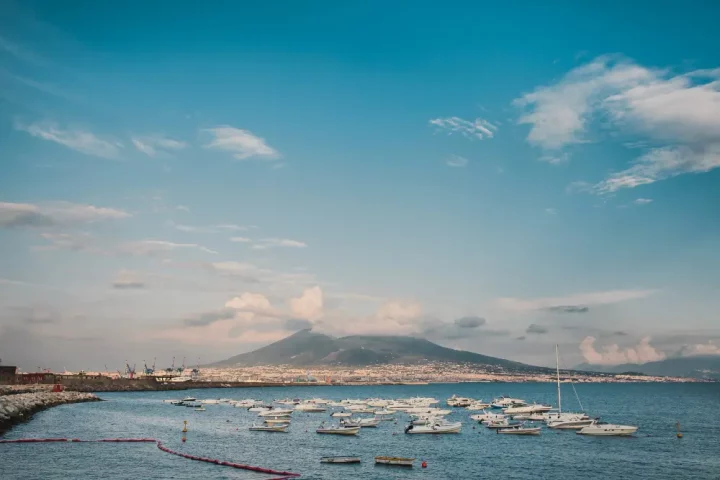
Mount Vesuvius, one of the most iconic volcanoes in the world, looms over the Bay of Naples on Italy’s western coast. Located in the Campania region, this stratovolcano is not only a geological wonder but also a symbol of both destruction and resilience. Its dramatic history, marked by catastrophic eruptions and enduring scientific intrigue, has made it one of the most studied and closely monitored volcanoes on Earth. Although currently dormant, Mount Vesuvius is still classified as an active volcano and remains a looming threat to the densely populated areas nearby, including Naples, which is home to over three million people.
Geographic and historical context
Mount Vesuvius is part of the Campanian volcanic arc, a chain of volcanoes formed by the subduction of the African plate beneath the Eurasian plate. What makes Vesuvius particularly unique is its position over a “slab window”—a break in the subducting slab—which has influenced the composition of its magma. Unlike neighboring volcanoes, Vesuvius primarily erupts andesite, a type of lava rich in silica (up to 63%), known for its explosive potential. This geological setting contributes to the volcano’s unpredictability and the intensity of its eruptions.
The volcano’s proximity to Naples and other towns in Campania has made it both a cultural landmark and a source of anxiety. Its fertile slopes have long attracted settlers, despite the risks, and today, the area around Vesuvius is one of the most densely populated volcanic zones in the world.
The Eruption of 79 A.D.
The most infamous eruption of Mount Vesuvius occurred in 79 A.D., a cataclysmic event that obliterated the Roman cities of Pompeii and Herculaneum. This eruption is estimated to have killed over 16,000 people, burying entire communities under layers of ash, pumice, and volcanic debris. The suddenness of the disaster preserved buildings, artifacts, and even the forms of victims in haunting detail, offering an unparalleled archaeological window into ancient Roman life.
One of the most valuable historical accounts of this eruption comes from Pliny the Younger, a Roman writer who witnessed the event from a distance. His vivid descriptions of the towering ash cloud and the chaos that ensued led volcanologists to coin the term “Plinian eruption” to describe similarly violent volcanic events characterized by high columns of gas and ash.
Take advantage of specialized assistance to secure your passport for a borderless future.
Eruption history and activity
Vesuvius has erupted many times over the past 17,000 years, with at least eight major eruptions recorded. After the 79 A.D. disaster, the volcano remained active for centuries, with frequent eruptions from the 1600s through the early 1900s. These events varied in intensity, often involving lava flows, ash clouds, and pyroclastic surges that caused significant damage and loss of life.
The most recent eruption occurred in March 1944, during the final stages of World War II. At that time, Italy was in political turmoil, and Allied forces were advancing through the region. The eruption destroyed several villages and caused the deaths of 26 Italian civilians. It also damaged dozens of U.S. military aircraft stationed nearby, though no military personnel were killed. The U.S. Army played a key role in evacuating residents and managing the emergency response.
Since 1944, Vesuvius has been quiet, but scientists warn that this period of dormancy does not mean the volcano is inactive.
Current risks and monitoring
Mount Vesuvius is currently in a dormant phase, though subtle signs of activity persist. These include faint, frequent earthquakes and fumaroles—steam vents—found within the Gran Cono crater and along the volcano’s slopes. These fumaroles result from water vapor rising to the surface, produced by the interaction between groundwater (both magmatic and non-magmatic) and heated underground materials.
To monitor the volcano, the Vesuvius Observatory employs a comprehensive system across Campania’s active volcanic zones, including Vesuvius, Ischia, and Campi Flegrei. This system includes:
- Seismic Monitoring: A network of fixed and mobile seismic stations detects ground motion. Sensors at each station transmit real-time data to a central surveillance center for analysis.
- Ground Deformation Tracking: Using precision leveling, clinometers, tide gauges, and GPS technology, the observatory monitors shifts in the terrain that may signal volcanic unrest.
- Gravimetric Field Analysis: Changes in gravitational acceleration are measured to detect movements of underground magma masses. These measurements are taken at all three volcanoes.
- Geochemical Surveillance: Specialized networks assess the chemical makeup of gases from fumaroles, soil, and water sources. Variations in these gases—especially those released from magma—can indicate a potential eruption. Hydrometric stations also track water levels and temperatures in Vesuvius and Campi Flegrei.
Together, these systems enable scientists to detect early warning signs and better understand the behavior of one of the world’s most dangerous volcanoes.
The Italian government has developed a comprehensive emergency plan that includes evacuation routes, transportation logistics, and temporary shelters. Additionally, efforts are underway to reduce population density near the volcano by limiting new construction and encouraging relocation.
A future eruption could reach a level 4 on the Volcanic Explosivity Index (VEI), which would result in widespread destruction and potentially catastrophic loss of life. Economic damages could exceed $20 billion, affecting infrastructure, housing, and tourism.
To prepare for this eventuality, Italy continues to invest in scientific research, public education, and emergency planning. Schools in the region conduct regular evacuation drills, and public awareness campaigns aim to ensure that residents understand the risks and know how to respond in the event of an eruption.
As one of the most studied volcanoes in the world, Vesuvius serves as both a scientific laboratory and a cautionary tale. Its past reminds us of nature’s power, while its future challenges us to remain vigilant, prepared, and respectful of the forces beneath our feet.