


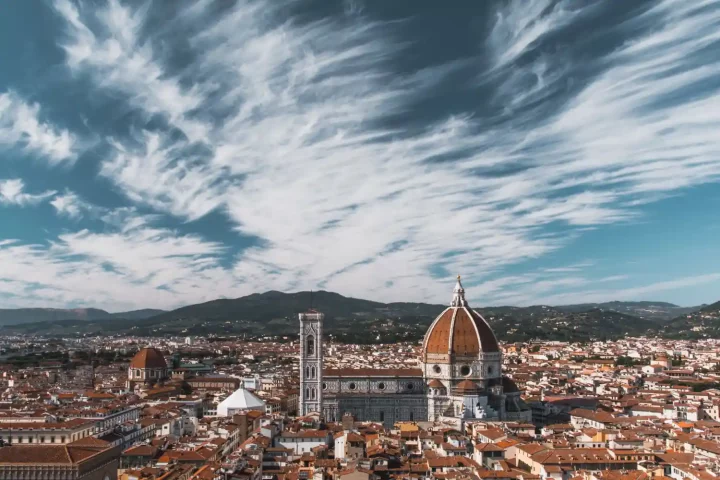
Florence’s Cathedral of Santa Maria del Fiore—commonly known as the Duomo—is one of the most iconic landmarks in Italy. Towering over the city’s skyline with its massive red-tiled dome, the Duomo is a symbol of Florence’s artistic and architectural legacy.
From its medieval foundations to its Renaissance dome, the cathedral tells a story of ambition, controversy, and cultural brilliance.
Historical context and cultural importance
The Duomo stands on the site of the ancient Cathedral of Santa Reparata, a 4th-century church that had served as Florence’s religious center for centuries. By the late 13th century, the city’s growing wealth and influence demanded a grander structure that would reflect its status as a cultural and economic powerhouse.
In 1296, architect Arnolfo di Cambio was commissioned to design a new cathedral that would surpass all others in size and splendor. His vision laid the foundation for what would become one of the most remarkable architectural achievements of the Western world.
The construction of the cathedral was not a continuous process. After Arnolfo’s death in the early 1300s, progress slowed until 1331, when the Arte della Lana—the powerful wool merchants’ guild—took over responsibility for the project.
In 1334, the renowned painter and architect Giotto was appointed as master builder, assisted by Andrea Pisano. He began work on the bell tower, or campanile, but died just three years later. Other architects continued the work, gradually expanding the structure and refining its design. However, constructing a dome to cover the vast central space remained a challenge.
Take advantage of specialized assistance to secure your passport for a borderless future.
The scale of the dome was unprecedented. Spanning over 140 feet in diameter, it was larger than any masonry dome built since antiquity. In 1418, a competition was held to find a solution, and the winner was Filippo Brunelleschi, a sculptor and architect.
Brunelleschi’s design was nothing short of revolutionary. He proposed a double-shell dome supported by a system of ribs and horizontal tie rings. The inner shell would provide structural support, while the outer shell would protect the dome from the weather and enhance its visual impact.
To ensure the dome’s stability and resist outward pressure, Brunelleschi incorporated horizontal tie rings made of stone and oak, reinforced with metal connectors, between the ribs. The dome’s inner and outer shells—stone at the base and brick above—were constructed without scaffolding, using measuring wires to maintain curvature.
Brunelleschi’s deep understanding of structural mechanics allowed him to build the dome in stable horizontal layers, and he engineered innovative wooden machines to transport materials efficiently during construction
Construction of the dome began in 1420 and continued for 16 years. By 1436, the dome was largely complete, and the cathedral was consecrated. The lantern at the top, designed by Brunelleschi, was added after his death, and in 1579, Giorgio Vasari began painting the massive fresco of The Last Judgement inside the dome.
Brunelleschi’s dome remains one of the greatest feats of engineering in history. It not only solved a seemingly impossible problem but also redefined architectural possibilities, inspiring countless Renaissance architects and earning Brunelleschi the title of the man who “renewed Roman masonry.”
Other features
- Giotto’s Bell Tower, an Italian Gothic masterpiece beside Florence’s Cathedral, rises 84.7 meters (278 feet) with a square base and striking marble cladding in red, white, and green. Designed by Giotto in 1334 and completed by Andrea Pisano and Francesco Talenti in 1359, the tower features elegant mullioned windows, three loggias, and 414 steps leading to panoramic summit balconies.
Its richly decorated exterior includes bas-relief panels depicting biblical creation, human activities, celestial powers, and virtues, along with a unique tympanum showing the Virgin Mary playfully tickling the infant Jesus.
Take advantage of specialized assistance to secure your passport for a borderless future.
- Across from the cathedral stands the Baptistery of San Giovanni, one of Florence’s oldest buildings, dating back to the 11th century. The interior of the Baptistery is enriched with Gothic furnishings and historic tombs, including Donatello and Michelozzo’s Renaissance monument to Cardinal Baldassarre Coscia.
Its three bronze doorways—now preserved in the Museum of the Opera del Duomo—feature masterpieces by Andrea Pisano and Lorenzo Ghiberti, including the renowned “Gates of Paradise” with Old Testament scenes.
The museum also houses other significant works once displayed in the Baptistery, such as Donatello’s wooden Penitent Mary Magdalene, the Pollaiolo Silver Cross and Altar, embroidered vestments of St. John, and sculptures by Rustici, Sansovino, and Danti.
- The Opera del Duomo Museum in Florence spans over 6,000 square meters across 28 rooms and three floors, offering a world-class showcase of faith, art, and history. Founded in 1891 and extensively renovated in 2015, the museum serves as an educational journey through the artists and monuments that shaped the Renaissance.
It houses original masterpieces by Michelangelo, Donatello, Brunelleschi, Ghiberti, and others, presented in cutting-edge architectural and museographic settings that honor their historical and artistic significance.
Fascinating facts and visitor tips
Visitors to the Duomo should dress modestly, as it remains an active place of worship. Tickets, which cost around €18, include access to the dome, baptistery, campanile, crypt, and museum. Climbing the dome’s 463 steps offers not only panoramic views of Florence but also a close-up look at Vasari’s frescoes and the dome’s intricate structure.
The crypt beneath the cathedral reveals the remains of Santa Reparata and offers a glimpse into early Christian Florence. Meanwhile, the museum and baptistery provide a rich context for understanding the Duomo’s place in art and history.
From its medieval foundations to its Renaissance innovations, the Cathedral of Santa Maria del Fiore stands as a monument to human creativity, faith, and perseverance. Whether you’re an art lover, history enthusiast, or curious traveler, a visit to Florence’s Duomo is an unforgettable journey into the heart of Italian heritage.