


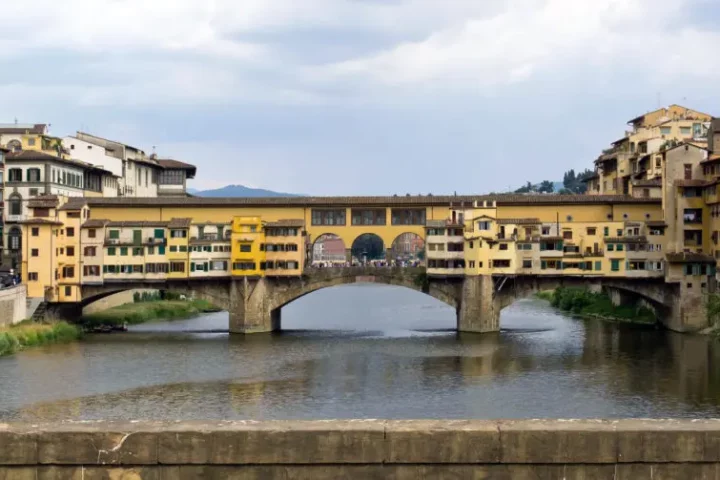
Nestled in the heart of Florence, Italy, the Ponte Vecchio is a living monument to the city’s resilience, artistry, and enduring charm. Spanning the Arno River near the Pitti Palace, this medieval structure has survived centuries of floods, wars, and urban transformation, all while maintaining its unique character and cultural significance. Today, Ponte Vecchio stands as one of Florence’s most beloved landmarks, drawing visitors from around the world to admire its architecture and browse its shops.
Historical context and significance
The name “Ponte Vecchio” translates to “Old Bridge,” and rightly so—it is the oldest bridge in Florence. Throughout its history, Ponte Vecchio has played a vital role in Florence’s development. Connecting key parts of the city and facilitating trade and movement, its strategic location made it a hub for commerce and a symbol of Florence’s economic vitality.
Architectural features and materials
The Ponte Vecchio, a remarkable feat of medieval engineering, has endured for over 600 years thanks to its robust construction. It features three shallow barrel vaults supported by two riverbank abutments and just two central piers, which are protected from the river’s current by triangular cutwaters. The bridge rests on underwater foundations made of concrete slabs anchored by sharpened oak piles driven deep into the riverbed. Its piers, built from large blocks of local pietra forte stone and cement, support the curved vaults formed with temporary wooden frameworks inserted into visible putlog holes. Once the mortar was set, these supports were removed, and the bridge’s roadbed was completed with durable paving stones.
Nicknamed the “Bridge of Gold” for its renowned jewelry shops, Ponte Vecchio originally served multiple roles in medieval Florence—as a bridge, a commercial street, and part of the city’s fortifications. Its central passage is flanked by four rectangular blocks of single-story shops built in a rowhouse style, sharing walls and now extending over the river on angled wooden supports called sporti. Historically, these shops aligned flush with the bridge’s edge and were topped with battlements featuring merlons and crenels for defense.
At the center of the bridge lies a nearly perfect square piazza offering scenic river views. The bridge’s layout followed a proportional design of 8:16:32 braccia (a Florentine unit of about 23 inches), with shops measuring 8 braccia wide and the street slightly wider than 16 braccia. This ratio reflects medieval urban planning practices, which favored clear, easily communicated dimensions without formal architectural drawings.
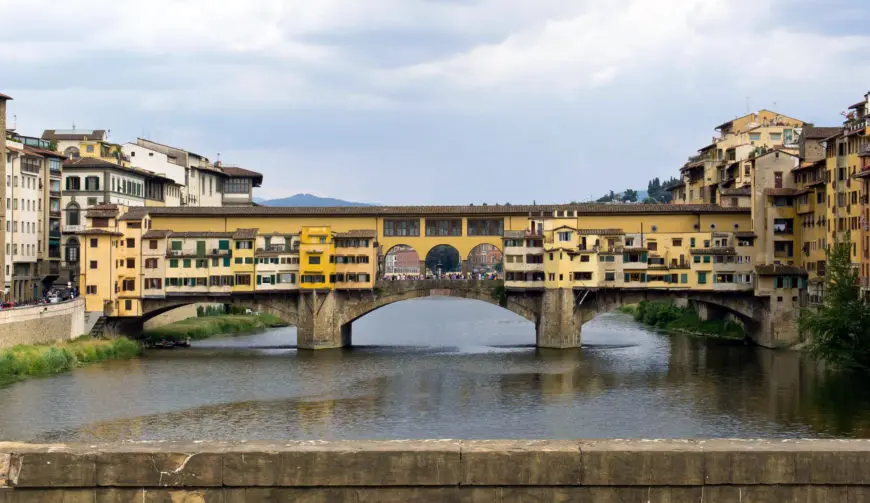
Each shop originally had a single archway entrance flanked by benches used for displaying goods or public seating, often for gambling. Wooden shutters secured the shops at night, and a marble sundial atop the northwest block helped track time. Decorative reliefs once adorned the upper levels, displaying civic emblems such as the Florentine lily, Guelf eagle, Papal keys, and symbols of the Tower Officials—who managed order and collected rent from city-owned shops until privatization in 1495. Records show a diverse range of merchants operated there, including grocers, butchers, barbers, and cloth dealers, until goldsmiths became the exclusive tenants in 1593 (Smarthistory).
Preservation and heritage protection
During the night of August 3–4, 1944, as Nazi forces retreated from Florence in World War II, they destroyed all city bridges except the Ponte Vecchio. While legend attributes its survival to Adolf Hitler, a plaque honors German consul Gerhard Wolf, and a recently uncovered letter suggests a courageous shop assistant may have defused the explosives.
The current structure was built between 1339 and 1346 by the Florentine republican government after a flood destroyed its predecessor in 1333. Archaeological evidence indicates that a masonry bridge may have existed on the site as early as 125 C.E., when Florence was a Roman colony. Before other bridges were built, an earlier medieval version of Ponte Vecchio served as the city’s sole permanent crossing, linking the civic center to the Oltrarno district and vital trade routes to Siena, Rome, and Pisa.
The bridge also withstood the catastrophic flood of 1966, when the Arno River overflowed and inundated the city.
Today, Ponte Vecchio is protected under Italian heritage laws, which safeguard its architectural integrity and cultural value. Local authorities actively monitor the site to prevent damage, including the removal of padlocks left by couples as part of a modern romantic tradition. In 2006, authorities in Florence took action by removing 6,000 padlocks from the Ponte Vecchio. To discourage the practice, local police now fine couples €50 for attaching locks to the historic bridge. While the gesture is well-intentioned, the locks pose a threat to the bridge’s preservation.
The bridge is also part of the Historic Centre of Florence, which is a UNESCO World Heritage site, adding another layer of protection.
Commercial legacy and traditional craftsmanship
Commerce has always been central to Ponte Vecchio’s identity. The bridge’s shop spaces were historically leased by the city’s government, providing a steady source of income and fostering a vibrant marketplace. Over time, the nature of the businesses evolved, with jewelers and goldsmiths becoming the dominant presence.
This tradition continues today, with many of the bridge’s shops specializing in high-end jewelry and artisanal goods. While prices can be steep due to the location’s prestige, the craftsmanship on display is exceptional.
Tourism and economic impact
Ponte Vecchio is one of Florence’s most visited attractions, drawing tourists year-round. Its picturesque views of the Arno River, historic ambiance, and unique shopping experience make it a must-see destination. Visitors often stroll across the bridge to admire the architecture, take photographs, and browse the boutiques.
The surrounding area is equally vibrant, with cafes, restaurants, and shops catering to tourists. While prices may be higher due to the “tourist premium,” the experience of dining or shopping near Ponte Vecchio is unmatched. For those seeking a quieter visit, early morning hours offer a more peaceful atmosphere, though shops typically around 9:30 in the morning
The bridge’s popularity contributes significantly to Florence’s tourism economy, supporting local businesses and preserving cultural heritage through sustained interest and investment.
Curiosities and historical anecdotes
Commissioned by Grand Duke Cosimo I in 1565 and designed by Giorgio Vasari, the Vasari Corridor was built in just five months to allow the Medici family discreet passage through Florence during a time of limited public support. This elevated walkway links Palazzo Vecchio, the seat of political power, to the Pitti Palace, the Medici residence, crossing the Arno River via the Ponte Vecchio. Despite damage during World War II bombings, when all other bridges were destroyed, the corridor remained the only route connecting the city’s north and south.
A symbol of resilience and cultural heritage
Ponte Vecchio is more than a bridge—it is a symbol of Florence’s enduring spirit, artistic legacy, and historical depth. From its medieval origins and commercial evolution to its survival through war and natural disaster, the bridge embodies the resilience and richness of Italian culture. Whether you’re admiring its architecture, shopping for handcrafted jewelry, or simply soaking in the views, Ponte Vecchio offers an unforgettable experience that connects past and present in one remarkable span.
References
Smarthistory. (n.d.). Ponte Vecchio, Florence. Retrieved November 4, 2025, from https://smarthistory.org/ponte-vecchio-florence/